The Silent One
The Painted BirdThe Silent One is an older, stronger boy at the Children’s home whose chosen silence first separates him from The narrator and later binds them together. Their friendship develops through rescue, signs, and shared excursions, but its most consequential turn comes after The narrator is attacked at the market: the Silent One’s presence at a train disaster, followed by his reaction to its victims, suggests that his loyalty has become bound to revenge. His sole audible speech comes only after that apparent reckoning fails to reach its intended target.
Identity and Chosen Silence
When The narrator meets him, the Silent One has not been heard speaking since his arrival at the Children’s home. The other boys know he is capable of speech; at some point during the war, he decided that speaking was pointless. The distinction matters to The narrator, who cannot speak. He fears that the friendship will make others mistake his own inability for a refusal, as if he could speak but simply would not.
The Silent One’s silence is therefore not just an outward resemblance to The narrator’s condition. It is a deliberate decision, maintained despite other boys’ attempts to make him speak and the punishment they inflict when he refuses. The narrator initially keeps his distance, interpreting that refusal as a possible mockery of boys who have no choice. Their later closeness does not erase this difference: the same outward silence has a different origin for each of them, and their friendship proceeds without making the two conditions interchangeable.
An Alliance Made Without Speech
The first decisive change comes when the Silent One intervenes in a corridor, stopping a boy who is beating The narrator. The next day, The narrator feels bound to take the Silent One’s side in a schoolyard fight. Their relationship begins not with an explanation or a declaration, but with reciprocal action: one boy protects the other, and the other answers in kind.
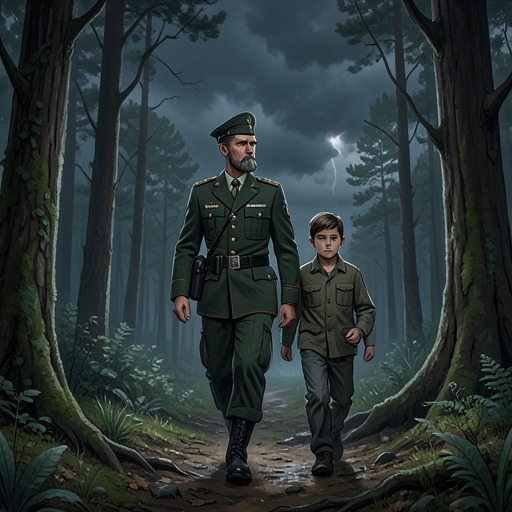
Afterward, they sit together at the back of the classroom. They begin by writing notes, then learn to communicate through signs. This gradual shift gives their silence a shared practical language, rather than leaving it as a barrier between them. The Silent One accompanies The narrator to the railroad station, where they befriend departing Red Army soldiers. They also steal a drunken postman’s bicycle and ride through a city park still closed because of land mines. Their excursions carry them beyond school routine, while the signs they use keep their companionship legible without speech.
At night they leave the dormitory and roam nearby squares and courtyards. They frighten couples, throw stones through open windows, and attack unsuspecting passersby. The narrator describes the Silent One as the stronger boy who takes the leading physical role. The friendship thus includes both protection and shared aggression: the boy who rescued The narrator also helps turn their pair into a source of danger to others.
The Market Attack and Its Aftermath
Weeks later, the two go to the local marketplace, where villagers sell food and handmade goods. Their earlier visits have involved small thefts, but this time The narrator knocks over a table of dairy products while looking at a militiaman’s bicycle. A farmer strikes him, then places him in an empty sauerkraut barrel and rolls it into a rubbish heap. The crowd laughs and calls The narrator a Gypsy stray.
The Silent One appears pale and shaking as he tries to get The narrator out. When the crowd mocks him and local boys interfere, he uses a club to keep them away and rolls the barrel toward a fountain. He supports The narrator on the walk back to the Children’s home and waits while a doctor treats him. The rescue echoes their first encounter, but this time The narrator is left hurt and unable to return the favor; the Silent One remains beside him through the aftermath.
The Train Disaster and the Failed Reckoning
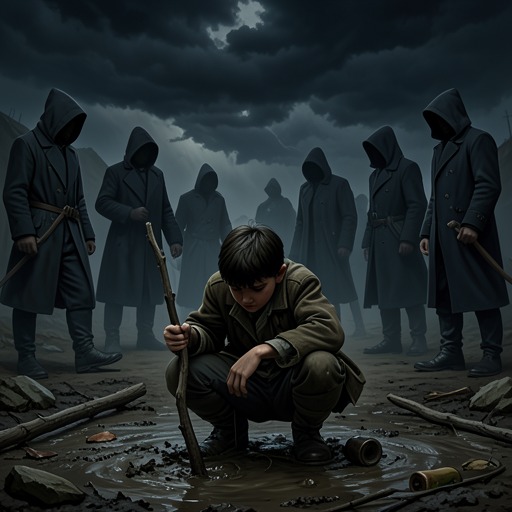
Two weeks later, the Silent One wakes The narrator before dawn. Dust-covered and perspiring, he signals for him to follow. He takes him to a derelict hut near the railroad crossing where they had oiled the points, climbs onto its roof with him, and waits as the morning train approaches. The train is crowded with market-bound villagers. As it reaches the crossing, the Silent One grips The narrator’s arm, and the locomotive veers aside. The carriages derail in a crash, and cries rise from below.
The Silent One then sags, watches the dust settle, and pulls The narrator away from the scene. They return to the Children’s home before the other residents wake. In the days afterward, newspapers print casualty names, police search for suspected saboteurs, and cranes lift the tangled carriages. The account connects the Silent One’s vigil at the crossing with the disaster, without describing exactly what he did at the moment the train left the track.
On the next market day, he takes The narrator back. Notices marked with black crosses identify stands whose owners have died, and the Silent One signals pleasure as he looks at them. They go to the stand of the farmer who attacked The narrator. The man is there, alive. The Silent One stares at him in disbelief; when he notices The narrator looking at him, he takes his hand and leaves. The sequence gives the disaster the shape of a revenge attempt, but its apparent purpose has not been fulfilled: the intended tormentor remains, while other people have died.
The Only Spoken Words
Once they reach the road, the Silent One falls onto the grass and cries as though in terrible pain. His words are muffled against the ground, but The narrator hears his voice. It is the only time he speaks. The moment reverses the terms of their bond: the boy whose chosen silence had once seemed to mirror The narrator’s inability now breaks it, not to explain himself or confess, but in a collapse of feeling after the market visit.
The Silent One’s arc is held together by acts that communicate more plainly than speech: rescuing The narrator, learning signs with him, accompanying him through the city, waiting outside the doctor’s room, and leading him to witness the aftermath of the train disaster. Yet that shared language cannot secure a shared understanding. The narrator can see the Silent One’s pleasure, disbelief, and grief, but the boy gives no verbal account of his actions or intentions. His final outburst makes the silence newly audible as a choice, while leaving its reasons unresolved.